
From invisibility cloak to Marauder's Map - AEMO’s market visibility framework

Putting the “Dumb” into “Dumbledore”
At the beginning of the year we wrote a post about 2025’s NEM wholesale market settings review (a.k.a. “The Nelson Review”), with a focus on what the review recommended for the demand side.
The review argued that there is a growing volume of small, behind-the-meter resources (e.g. batteries and flexible loads) responding to spot prices outside of central dispatch. Under the current National Electricity Rules, these sorts of assets are not required to signal their operational intentions to the market like scheduled generators and loads. Consequently, how these resources operate is “invisible” to AEMO, which may mean that it over- or under-forecasts load, which may in turn result in inefficient spot price outcomes and increased Regulation FCAS costs.

Middle child syndrome
To address this, the Nelson review recommended that AEMO develop a mandatory framework for the visibility and dispatch of certain price responsive resources not otherwise covered by scheduling requirements. All Energy Ministers (except Queensland’s) gave in principle agreement to this recommendation in late 2025, so AEMO kicked the design process off earlier this year.
In this post, we’ll explain where things are up to with what’s now called the “market visibility framework” (MVF), what to expect next, and how it might affect the development of behind-the-meter batteries.
Four modes
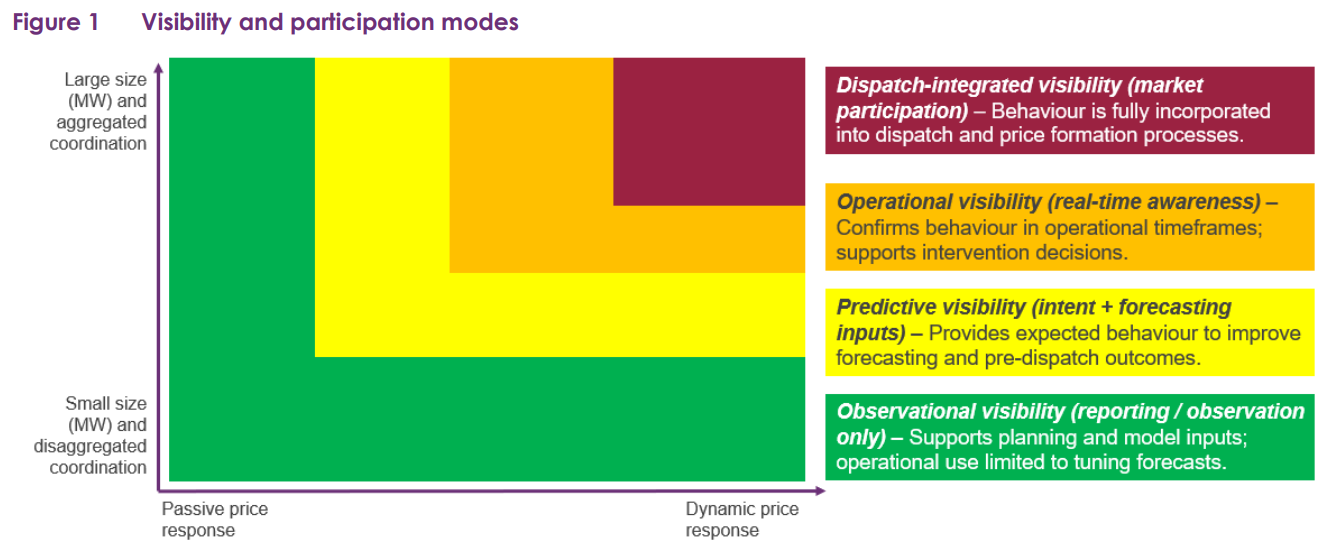
AEMO recently published a consultation paper setting out its proposed design for the MVF and seeking stakeholder feedback. Its proposal is to introduce four visibility and participation modes across a continuum - with different resource types and “the extent of coordination” determining which mode applies to whom.
Source: AEMO consultation paper
The general idea is that if an asset or aggregation is small and uncoordinated or passive in its price-responsiveness, AEMO will use enhanced standing or historical data to improve its statistical understanding of how that asset or aggregation might respond in future (the green zone). If the asset/aggregation gets bigger and responds more actively and dynamically to spot prices, AEMO will impose obligations to provide information about its intentions on increasingly real-time timeframes (the yellow and orange zones). If AEMO deems that these visibility obligations aren’t sufficient to manage any negative impacts of the asset/ aggregation’s operations, AEMO will require it to fully participate in central dispatch and price formation processes (the red zone).
“Homenum revelio” - who’s under the cloak?
Below is a rough summary of who AEMO is trying to capture in each of the modes, and what sort of obligations they’d be subject to.
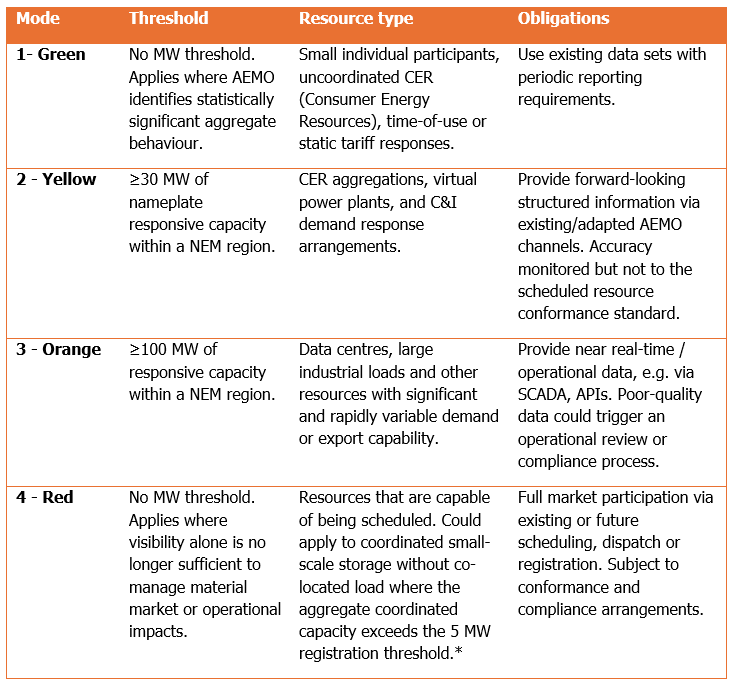
* Note, it’s unclear whether the 5 MW threshold would apply on a NEM-wide or per NEM region basis.
Where thresholds are proposed for Modes 2 and 3, it’s good to see AEMO proposing them in relation to the amount of responsive capacity, not installed capacity.
How it might affect Unscheduled BESS
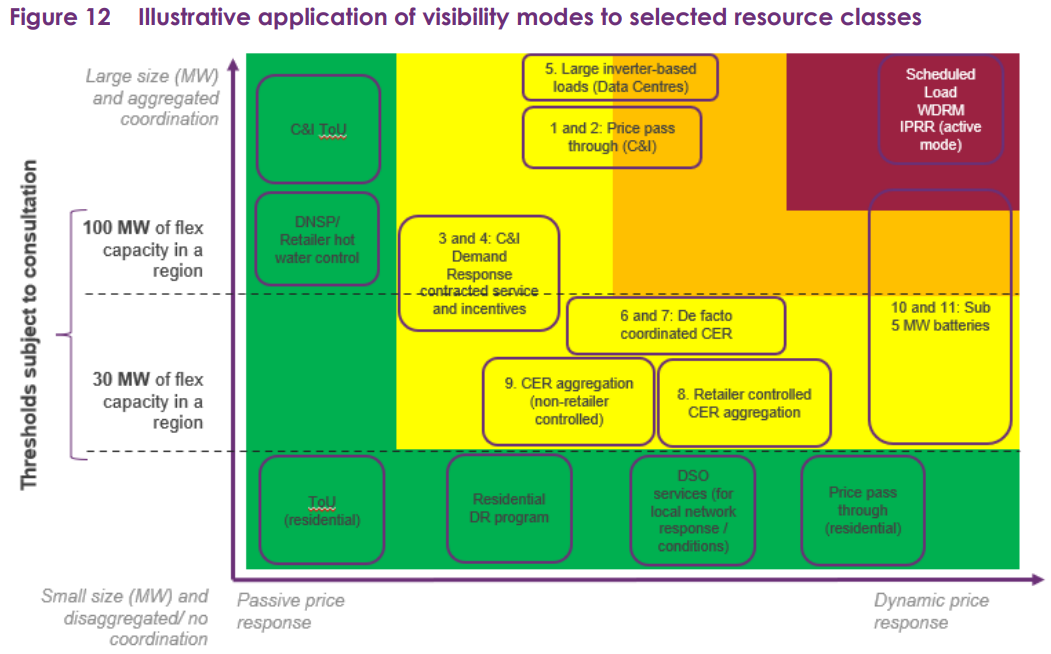
The paper maps out where different business models and asset types might fall.
Source: AEMO consultation paper
At this stage, an individual BESS co-located with C&I load might be captured under the Mode 1 - Green obligations. If you’re a part of a bigger portfolio, your provider might find itself subject to the Mode 2 - Yellow obligations, in which case some of the data requirements and costs of compliance might make their way to you. If you’re in the business of installing portfolios of <5MW standalone BESS (i.e. no co-located load) then watch out: the Mode 4 - Red obligations might be coming for you. The paper doesn’t explicitly discuss solar and BESS (hybrid) sites as a distinct category - the focus, at this stage, appears to be on batteries only.
The big question is who the obligations should apply to - the customer? The FRMP? The third-party aggregator? The optimisation platform provider? The paper canvasses all of these options. AEMO's starting position is that the obligations should sit with the FRMP or NER-registered service provider. Where a third party (e.g. an optimisation platform provider) actually manages the resource's behaviour, contracts with that party may need to include provisions enabling the FRMP or service provider to meet those obligations.
I solemnly swear I am up to no good
The theory is that improved visibility will benefit consumers through more efficient spot price outcomes, reduced reserve and intervention costs and better planning signals. The current direction of wholesale price spreads and FCAS prices with the growth of “invisible” CER capacity does not lend much weight to this theory. Nevertheless, AEMO recognises that the benefits will only outweigh implementation costs if the framework actually improves forecast accuracy and participant decision making. In a promising sign, AEMO indicates it will build evidence of this before activating detailed obligations.

See? We give credit where it’s due.
Perhaps given the uncertainty around potential costs and benefits, AEMO has proposed a fairly slow implementation pathway, with stage gates in place before any obligations take effect. This is a sensible approach, as is AEMO’s proposal to first “improve its ability to identify, forecast and understand price-responsive behaviour using current systems, market processes and participant data channels.”
It’s not entirely clear how this framework links in with the Integrating Price Responsive Resources rules, which will introduce voluntary dispatch arrangements for unscheduled resources and for which implementation has been delayed. AEMO has also submitted a rule change request seeking to improve operational visibility of large inverter-based loads like data centres.
Do we need all of these? Who knows. It seems AEMO is covering all bases. If all three initiatives are implemented, AEMO will have a right Marauder’s Map of the energy market - giving it continuous, granular visibility of all participant activity and more control of some.
Can’t call it “Dark” anymore, wokeness gone mad
The Wizengamot will decide
The Nelson review’s draft report recommended that the visibility framework be developed by the AEMC through a rule change process. That’s the most common way for changes to the NEM’s rules to be made. But the review’s final report changed course and instead recommended that Energy Ministers make the rule themselves.
As a result, whether or not the MVF framework gets up will depend on the mood and composition of the Energy Ministers’ room come December. Queensland never agreed to the original recommendation at the end of 2025, and all signs since indicate they’d rather go their own way on energy policy. Victoria has an election in November, and primary polls are tight and volatile - who knows who’ll be sitting in the Minister’s seat come December?
Can some Energy Ministers make a rule if others opt out? I don’t know - ask a lawyer. Would the framework be useless and expensive if you only had a couple of NEM jurisdictions participating? Yeah, probably.
So what?
We’ll keep watching this space. Stakeholder comments on the consultation paper are due mid-October, if you’d like to make your views heard.
If implemented, it’ll have ramifications for both standalone and co-located Unscheduled BESS, anywhere from a requirement to provide historical data to providing real-time telemetry data and complying with dispatch conformance obligations.
Don’t get spooked yet - a few jumps need to be cleared for this to get up, and then there’d be detailed design and stage-gated implementation. The paper doesn’t set out a timeline for these stage gates, but does note the Nelson Review's expectation that the framework "enable full implementation by 2030".
Either way, the visibility and dispatchability of unscheduled resources is a hot topic. It might not be the MVF, but it’s reasonable to expect that AEMO will make you take your invisibility cloak off at some point.